By Elizabeth Herman | Posted: November 20, 2019

“It is sacrifice that makes life worth living. The amount of sacrifice in your life brings out your magnanimity and helps you move out of misery. A life without sacrifice is worth nothing. Zeal, enthusiasm, strength and joy all come from sacrifice.” - Gurudev Sri Sri Ravi Shankar
100,000 people in the U.S. are waiting for kidney transplants, and the idea of a kidney transplant chain is helping to solve that problem. In these organizations, U.S. organ donors find it very rewarding to come together with the recipients of their donations, and realize how saving lives through sacrifice makes perfect strangers feel like they’re part of the same family.
Sometimes the stories told throughout the generations contain universal values that bring together people of diverse backgrounds. For instance, Gurudev Sri Sri Ravi Shankar supports the value of sacrifice in cases where organ donation is needed to save lives. He offers evidence from Hindu tradition, showing the favorable view of organ donation in his culture and tradition.
Views on organ donation
A participant in the Art of Living recently asked a question and got a very interesting answer from Gurudev Sri Sri Ravi Shankar. One of the teachers asked, on behalf of the participant, “Gurudev, my question is what is your view on organ donation? Do you support this?”
The answer revealed a lot about Indian customs and beliefs, and the values of selflessness and letting go, particularly concerning the body and how it is represented symbolically. You can see the full answer in this video.
In the video, Gurudev says, “Yes, yes, yes! See, organ donation has been part of our tradition for a long time. It’s nothing new. People would even make wishes ‘If I have a leg problem. I will come and donate my leg (symbolically).’ So if you see all the big temples in south India, outside, they have different parts of the body being sold there, in silver or gold. They sell legs or ears or eyes. Different parts of the body are sold. So when they make a wish that this organ of mine should become healthy and become free from disease, so they say 'I will donate an organ (symbol).'
The seed of giving is there. Instead of donating real organs, they put the metal pieces on the after deities. They pray for the idea that “after I’ve used this body, may this body continue to help someone.” And Gurudev introduces a fascinating tale of a hunter who gave up his eyes for his newly discovered God.
The story of Bedara Kannappa
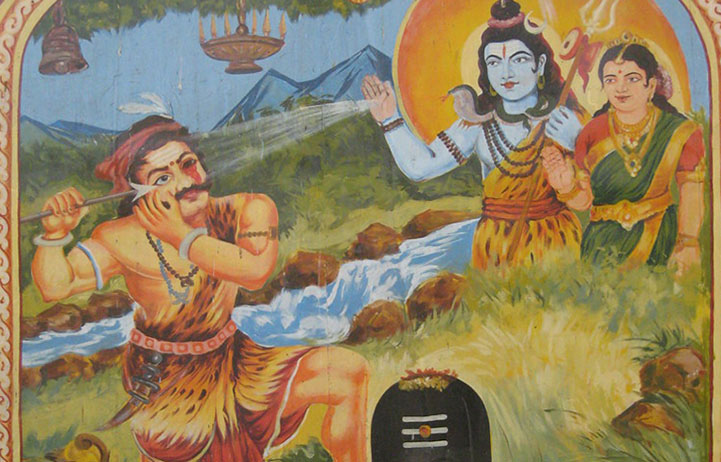
The story of a character in Hindu mythology, who donated his eyes to lord Shiva and received the reward of spiritual liberation, illustrates how the culture looks favorably on people who sacrifice physical abilities and organs to help others. “Bedara Kannappa, in only 6 days, got enlightened. What did he do? He was a hunter and never worshipped or went to a temple, but he saw a shiva lingam (an abstract, devotional representation, or symbol of lord Shiva in Hinduism) in the forest.”
“And once, he was very hungry and couldn’t hunt anything at that time and he found the food offerings in front of the altar to God, ate them, and converted into a believer. He was attracted and became God’s friend on the second day, the third day and the fourth day. He saw, on one of the eyes of Shiva’s statue, some blood coming out of the eye, oozing out.”
“He said ‘Oh something has happened to your eyes. But you’re ruling the world so your eyes should be OK. I can manage with one eye.’ He took one of his eyes and put it there.” By sacrificing and giving his own sense of sight to his lord, not only did the hunter become enlightened in his mind, but he also showed the devotion and sincerity of his change of heart about religion.
The myth of a curse on organ donation
Gurdev disputes ideas about organ donation being dangerous to your future spiritual lives, asserting that “There’s nothing wrong with donating organs. Transplanting the organs has been there from a long time ago in India.”
“Don’t think that if you donate your liver, kidneys or heart, you won’t get what you want in the next life. Or, that you’ll have a problem about it in the next life. This is a wrong conception that people have. They say, ‘Hey don’t donate your liver. Next time you will be born without a liver.’ This is nonsense. You can donate all the organs of the body, so they’ll help somebody else.”
The body is like a garment

“It’s like donating your clothes. Your parents have donated these clothes of yours. When you grew up, your children’s clothes were donated to other kids, weren’t they?” asks Gurudev to his enthralled audience.
He explains, “As you grow older, and the clothes don’t fit you, you remember that some kids grow very fast. Every two months, three months you have to change your clothes. Some of them grow horizontally and vertically, and the clothes don’t fit, but they’re very good clothes so they don’t throw them away, but donate them instead.”
“The clothes don’t fit and they are very nice clothes. In the same way the body is like a cloth. It’s like a garment, and any part of it can be used for others, so it can save so many lives. So don’t think you won’t get liberation or you’ll be cursed if you donate parts of the body. You can easily do it. In fact, it brings you more merits.”
Gurudev’s talk shows how the universal values of self-sacrifice and letting go for the sake of other people can lead to great achievements for the world. In a similar way, some Christians use symbols of the sacred heart to remind them of the holiness of kindness and compassion, embodied by Jesus. And the Jewish people, and ancient Greeks as well, have the symbol of the hand with an eye on it, to show how helping others, by lending a hand in service, can make one more of a visionary.
Elizabeth Herman writes, offers writing support to clients, teaches, and volunteers for a better world. She has a PhD in Rhetoric, Composition and Literature. Find her on Facebook or Twitter.


